
Buying Guides
Pool sizes What fits your terrace, lawn or farmhouse

Choosing a pool size is the step most people get wrong. Too small and the family outgrows it in a week. Too big and it will not fit, or it needs more water than you can easily get. This guide shows you how to measure, plan and pick the right size for your space.
Measure your space first
A pool listed as 12 feet across needs more than 12 feet of space. You need room for the ladder, the pump, a walkway and some safety margin.
- Measure the flat area you plan to use, length and width.
- Subtract about 1 metre (3 feet) from every side for clearance.
- What is left is the biggest pool footprint that really fits.
- Check overhead for tree branches, wires and balcony edges.
Lay a rope or a few bedsheets on the ground in the exact pool shape. Leave it for a day. If you keep tripping over it or it blocks the gate, go one size smaller.
Pick the shape: round, rectangular or oval
Round pools
Round pools are the most common and the easiest to set up. They suit square or irregular spaces and are great for splashing around and relaxing. See our Steel Pro MAX round frame pools.
Rectangular pools
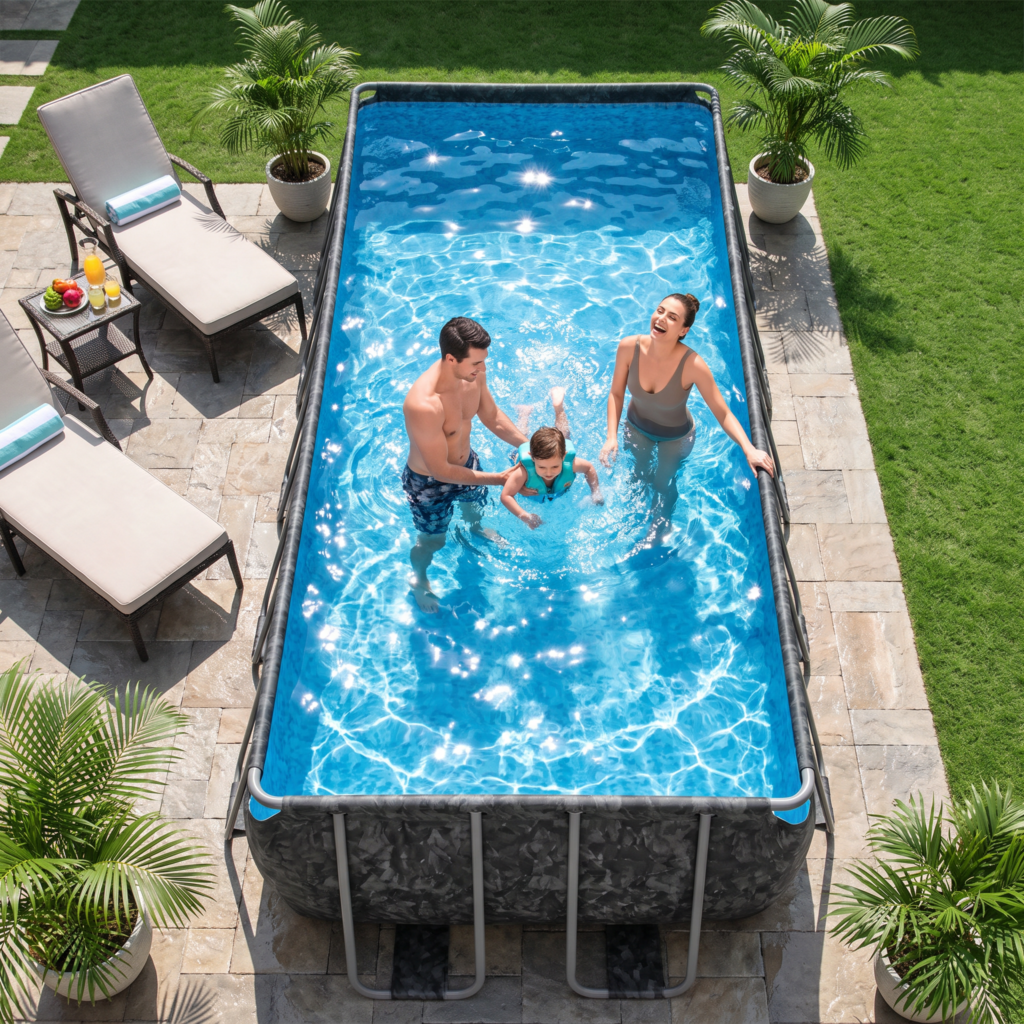
Rectangular pools use long, narrow spaces well, such as the side of a house or a long lawn. They are better for swimming laps and give a modern look. Check the rectangular and oval Steel Pro MAX pools.
Oval pools
Oval pools sit between the two. They give a long swimming line with softer corners and look good in a garden setting.
Match size to the people using it
Think about how many people will be in the water together, not the total number in the house.
| Who is swimming | Pool idea | Space to plan |
|---|---|---|
| 2 to 3 small kids | Small round, 8 to 10 ft | About 4 x 4 m including clearance |
| Family of 4 to 5 | Round 12 to 15 ft, or small rectangular | About 5 x 5 m to 6 x 5 m |
| Larger family, regular guests | 15 ft and above, or large rectangular | About 7 x 5 m and up |
| Fitness and lap swimming | Longest rectangular you can fit | Length is what matters |
These are only rough guides. Always check the exact dimensions on the product page before you order.
Terrace, lawn or farmhouse: what changes
On a terrace
Weight is the main limit. One litre of water weighs about one kilogram, so a pool holding 10,000 litres puts around 10 tonnes on your slab. Before you plan any pool on a terrace, get an engineer to confirm that your slab can carry it. Choose a smaller, shallower pool and keep it away from edges.
On a lawn
Lawns are the easiest. Look for the flattest patch, away from tree roots and sprinklers. Remove grass and stones from the base, and use a ground sheet. Make sure you can reach a tap and a power socket safely.
On a farmhouse
Farmhouses usually have space for a large rectangular or oval pool and a seating area. Watch for hard borewell water, and plan how you will keep the pool covered when nobody visits for the week.
Never put a pool on a slope, soft soil or an unchecked terrace. And always keep a responsible adult watching children in and around the water.

Water volume and the filter pump
Bigger pools need more water and stronger filtering. Here is a quick way to think about it.
- A larger pool takes longer to fill. If you use tankers, plan the delivery in advance.
- A larger pool takes longer to heat or cool naturally through the day.
- For bigger sizes, a sand filter pump is usually a better match than a small cartridge pump.
Once you know your size, you are ready to order. KOKOKOKO imports each pool to order. You book with a 30% advance, the pool ships in about 4 to 7 weeks, and the remaining 70% is paid on arrival at our Bangalore warehouse, before dispatch. Sizes marked In stock are simpler: you pay in full and get delivery in about 1 week. Browse all pools and compare sizes.
A quick worked example
Say you have a lawn that is 8 metres long and 6 metres wide. Take away 1 metre of clearance on every side. That leaves 6 by 4 metres of usable space. A 15 foot round pool is about 4.6 metres across, so it fits. A larger rectangular pool might also fit lengthwise, but check the exact footprint. Now you know your real limits before you fall in love with a size.
Three common mistakes
- Measuring the pool, not the space around it. Always add the clearance.
- Ignoring the water source. Know where the hose reaches and how you will fill it.
- Forgetting the future. If kids will grow or guests will come often, go up one size within your limits.
If your space is small, a good option is a compact round pool with a cover, which you can leave up through the season. If your space is generous, think about adding a seating area and shade, so the pool becomes the centre of weekend plans.
Think about the surroundings too
A pool is not just a tub of water. You will want somewhere to dry off, a place for slippers and towels, and shade to rest in. Leave room for a small table or a couple of chairs. If you can place the pool where it gets morning sun and afternoon shade, the water stays pleasant for longer in the day.
Also consider where the water will go when you drain it. A gentle slope away from the house, or a drain you can reach with a hose pipe, will save you a messy afternoon at the end of the season.
Frequently asked questions
How much space do I need for a 12 foot pool?
Plan roughly a 5 x 5 metre flat area, which gives you clearance on all sides for the ladder and pump. Always check the exact specification.
Which is better for a small garden, round or rectangular?
Round is simpler for squarish spaces. Rectangular uses a long, narrow strip better. Measure your space and test the shape with a rope.
Is deeper always better?
No. Deeper pools need more water and stricter supervision. For families with young children, a shallower pool is often the safer, more comfortable choice.
Can I fit a pool in a society compound?
Check your society rules and get permission first. Some societies restrict pools or have safety conditions.
Send us your measurements
Share your space size on WhatsApp and we will suggest pool sizes that fit comfortably.
View poolsChat on WhatsApp