
Pool Care
Save water Refill, top-up and reuse in water-scarce cities

Many people hesitate to buy a home pool because water is precious in cities like Bengaluru, Chennai, Hyderabad and Delhi. The truth is that a well-run above-ground pool uses less water than most people expect, since you fill it once and then only top up. With a few smart habits you can enjoy the pool and still be a responsible water user.
How much water does a home pool really use
A pool uses water in three ways: the first fill, top-ups to replace evaporation and splash-out, and the occasional partial change. After the first fill, the main loss is evaporation. In hot, dry, windy weather, as in Rajasthan, Gujarat or Delhi in May, this can be noticeable. In humid cities it is lower.
Most losses are easy to cut. Covering the pool, keeping the water balanced so you do not need to drain it, and reusing water in the garden all help. Exact numbers depend on pool size, weather, wind and use, so measure your own pool rather than relying on general figures.
Fill smart: the first refill
The first fill is the largest single use of water, so plan it well.
- Choose the right pool size. Bigger is not always better. A pool that matches your family needs will fill faster and use less water. See our guide on pool sizes to match your space.
- Collect water over time if your supply is limited. Fill a sump or tank and then top up your pool from it.
- Use a tanker only from a reliable supplier, and share it with neighbours if you can.
- Check your water quality before filling. Good water means you will not need to dump it later.
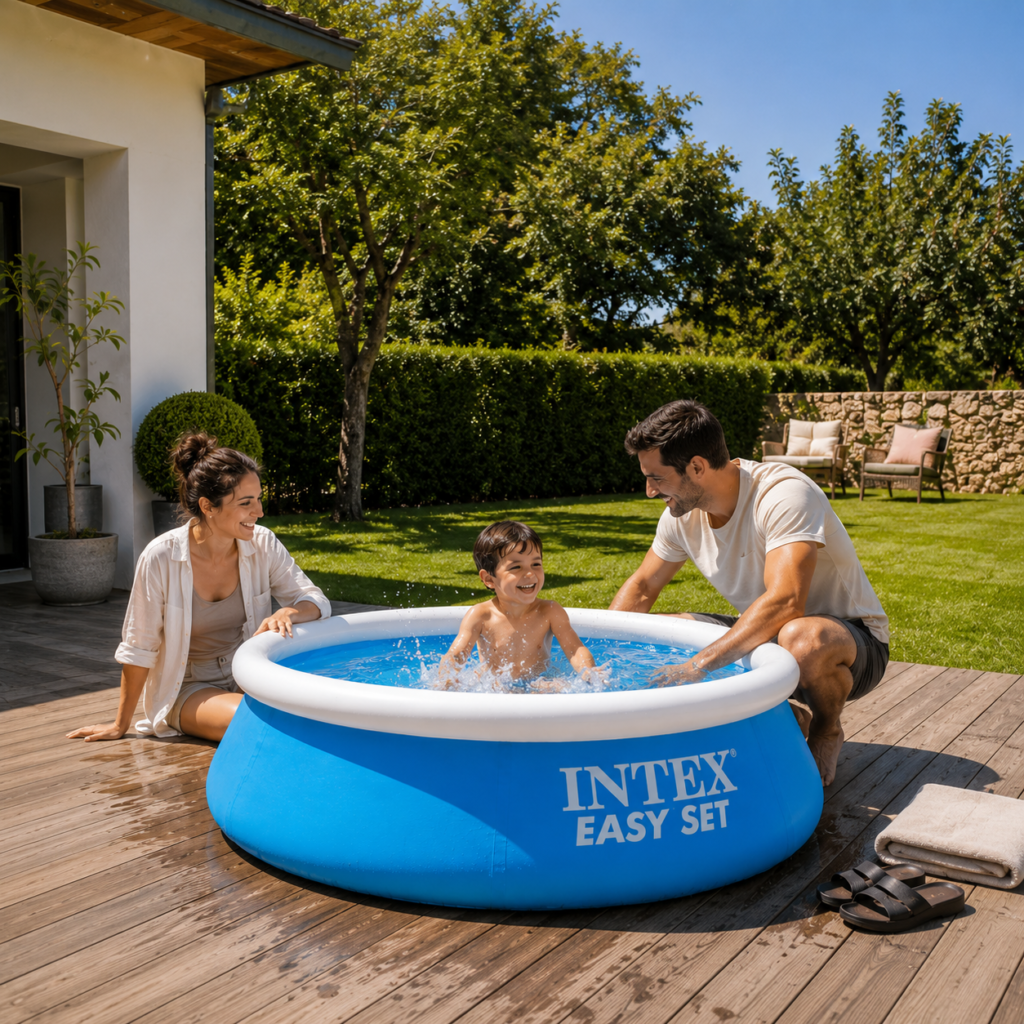
Inflatable pools are naturally modest in volume, which suits homes where water is a concern. Our Easy Set and Fast Set pools hold less water than large frame pools, and still keep a family cool. If you want something bigger, our frame pools come in many sizes.
Top-up and evaporation control
Evaporation is the quiet water thief. Here is how to reduce it.
Use a pool cover
A cover is the single most useful thing. It cuts evaporation, keeps dust and leaves out, and also helps hold heat in cooler months. Cover the pool every evening and whenever nobody is using it. A cover is also a safety barrier for children and pets, but it is not a substitute for supervision or a proper fence.
Choose the right spot
If you are still planning, put the pool in a spot that is sheltered from strong wind and partly shaded in the afternoon. Wind and direct sun speed up evaporation. A shade net or a pergola can help, as long as leaves do not fall in.
Top up in small amounts
- Mark the normal water level inside the pool and check it every morning.
- Top up a little and often instead of waiting for a large drop.
- Do not overfill. Extra water spills out when people get in.
- Fix leaks early. A slow leak wastes a lot of water over weeks. A small patch, which is often included with the pool, can fix a puncture.
Tape a strip of waterproof tape inside the pool at the right water level. A quick glance tells you if you have lost water, and it lets you tell evaporation from a leak.
Reuse pool water the right way
Pool water has chlorine and other chemicals, so reuse it carefully. Do not simply pour it onto plants or into the lake or a stream.
| Use | Is it suitable? | Notes |
|---|---|---|
| Garden lawns and shrubs | Often yes, after chlorine fades | Let it stand in the sun for a few days and test it first |
| Washing the car or the floor | Usually yes | Fine once the chlorine level is low |
| Flushing toilets | Yes | Carry it in buckets after chlorine is low |
| Vegetables, fruit trees | Be careful | Check salt and chemical levels. Avoid if unsure |
| Fish ponds, wells, streams | No | Chlorine and chemicals can harm life and contaminate water |
To dechlorinate naturally, leave the water in an open tank in the sun for a few days without adding new chemicals. Test it with your kit before using it. If you are unsure, ask your local gardener or a water expert. Always check local rules and your society guidelines before draining pool water.
Cut water use with good care
The best way to save water is to keep your pool healthy so you never have to dump it.
- Keep chemistry balanced. Regular pH and chlorine checks prevent the green-water problem that forces owners to drain.
- Run the filter daily. Good circulation and clean cartridges keep water clear for months.
- Skim and brush. Taking out leaves early reduces what the filter has to do.
- Shower before swimming. This keeps oils, sweat and sunscreen out of the water.
- Limit splash-out. Keep the water level a little below the top and keep the pool away from kids’ water-fight corners.
- Use a pool cover during monsoon. It keeps dirt out so you can avoid costly clean-ups.
If your water is hard, scale and cloudiness can build up and push owners to drain early. Our guide to hard and borewell water explains how to avoid that. Partial changes, replacing a small part of the water instead of all of it, are usually enough.
Do not drain a frame pool completely and leave it empty in strong wind or rain. An empty liner can shift or get damaged. Drain only when you are ready to dry, fold and store it, and never leave pool chemicals where children can reach them.

A simple water-saving plan
- Pick a pool size that fits your family and space.
- Fill once, using a tank or tanker with good water.
- Use a cover every evening and in windy weather.
- Test and balance the water twice a week.
- Top up small amounts, and mark the level.
- Reuse any drained water in the garden or for cleaning, after chlorine has settled.
- Pack up the pool properly if you will not be using it for a long period.
KOKOKOKO imports genuine Bestway and Intex pools to order across India. If you want help choosing a size that suits a small plot or a water-limited area, share your space and family size on WhatsApp. Booking needs a 30% advance, delivery takes 4 to 7 weeks, and the 70% balance is paid on arrival at our Bangalore warehouse before dispatch. Sizes marked In stock are simpler: you pay in full and get delivery in about 1 week.
A home pool is a lifestyle choice, and it can be a responsible one. Always keep children under adult supervision while swimming.
Frequently asked questions
How much water will my pool lose every week?
It depends on size, heat, wind and whether you use a cover. Measure your own loss by marking the water level and checking it over a few days.
Can I use pool water for my garden?
Often yes, after the chlorine level has dropped and you have tested it. Avoid edible plants if you are unsure, and never send it to ponds or wells.
Is a smaller pool a better choice for water-scarce cities?
Usually yes. A smaller or inflatable pool needs less water to fill and maintain, and it still gives a family plenty of enjoyment.
Does a pool cover really help?
Yes. A cover reduces evaporation, and keeps out dirt, so you top up less and need fewer chemicals.
Find a pool that fits your space and water supply
Tell us your plot size, family size and city, and we will suggest a pool that makes sense.
See all poolsChat on WhatsApp