
For Business
School pools Play schools and summer camps: safety and options

Water play is one of the most loved parts of a summer camp or school activity day. But when the swimmers are children, safety comes first, always. This guide explains how schools, play schools and camp organisers can think about pool options, supervision and set-up in India.
Why institutions look at portable pools
Many schools and play schools do not have the space, budget or approvals for a full-size swimming pool. Summer camps often run for just a few weeks, and a permanent pool would sit idle the rest of the year. A portable above-ground pool fits this pattern better.
Here is why institutions consider them:
- Seasonal use: set up for summer camp, then drain, dry and store.
- Lower cost: no excavation or tiling, and the cost is typically far below a built pool. Exact amounts vary.
- Flexible size: from small splash pools for toddlers to larger frame pools for older children.
- Quick installation: many pools can be ready in a day once the ground is prepared.
- Activity variety: water play, learn-to-float sessions, sports day events and fun days.
Still, a portable pool is not a toy. It holds a lot of water, and any water deeper than a few centimetres can be dangerous to young children. Every plan must begin with safety and supervision.
Safety first: supervision and rules
This is the most important section of this guide. Children can get into trouble in water very quickly and silently. An adult must always be watching, and the pool should never be used without supervision.
Never leave a child alone in or near a pool, even for a moment. A portable pool wall is not a safety barrier. Keep a trained adult within arm reach of very young children at all times.
Supervision rules
- Assign dedicated pool watchers whose only job is to watch the water, with no phones or paperwork
- Keep a clear adult-to-child ratio. Use a lower number of children per adult for younger groups, and follow your school or local guidelines
- Do a headcount before, during and after each session
- Use a whistle or a clear signal for “everybody out”
- Have at least one adult trained in first aid and CPR on site
- Keep a first-aid kit, a ring buoy and a phone within reach
- Never allow diving or running around the pool
- Children enter and exit only with permission and only by the ladder or steps
Parental consent and health
Take written permission from parents for water activity. Ask about allergies, ear or skin conditions, asthma and any medical issues. Children with health concerns should join only after a parent or doctor confirms it is safe.
Fencing and access
Keep the pool in a closed area, away from the main play ground. Use a lockable gate or barrier, and cover or empty the pool when the session ends. The ladder should be removed or locked when no adult is present. Also keep chemicals stored securely, away from children.
Choosing the right pool for the age group
Different ages need different pool types and depths. A shallow, small pool is not just easier, it is also safer.
| Age group | Pool idea | Notes |
|---|---|---|
| Toddlers and play school (2 to 5 years) | Small inflatable or splash pool, shallow water | Adult within arm reach. Keep water very shallow |
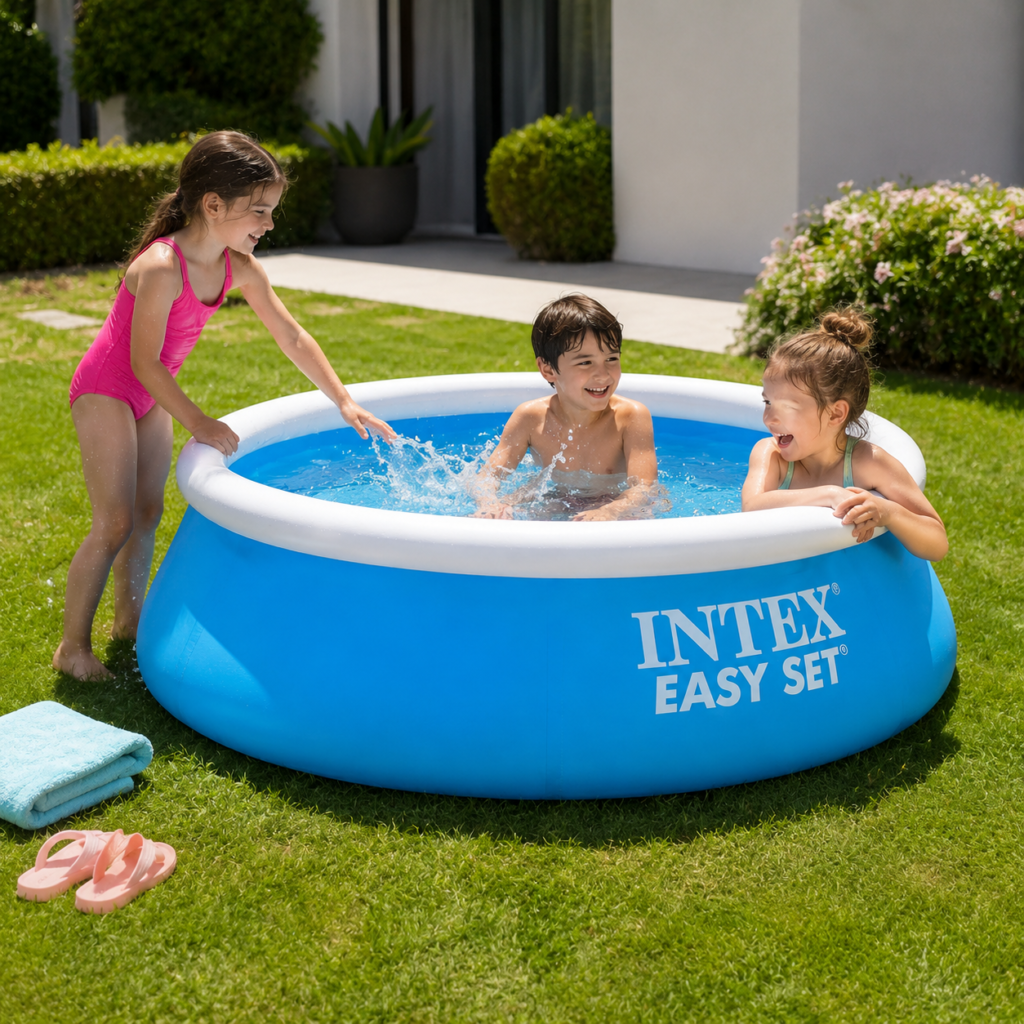
| Primary school (6 to 10 years) | Inflatable Easy Set or Fast Set, or small round frame pool | Supervised play, learn-to-float, games |
| Older children (11 and above) | Round or rectangular frame pool | More space for activities and races |
| Mixed-age summer camp | Separate shallow pool and larger pool | Keep age groups apart |
Our inflatable Easy Set and Fast Set pools are quick to set up and good for younger kids, with lower water volume. For older groups and regular use, frame pools give a sturdier build and more room. We also stock water play centres, which add slides and sprays for fun in shallow water.
Keep two zones: a small shallow pool or splash area for the youngest, and a larger pool for older children. Mixing very different ages in one pool makes supervision harder.
Setting up, water care and hygiene
A school pool sees many children, so water hygiene matters more than at home.
Site and set-up
- Choose flat, firm ground, such as a levelled courtyard or a cleared playground corner.
- Make sure the area has shade, since children and water both suffer in harsh midday sun.
- Keep the pool away from roads, gates, drains and electrical points.
- Use a ground cloth and clean the area of stones and sharp objects.
- Place the filter pump on dry ground with a safe, covered power connection and a proper earthing, as advised by an electrician.
Water care
With many children in the water, keep the filter running and test chlorine and pH before every session. Plan for hard water, dust and high temperatures in summer. Our guide on pool water care for Indian summers is a good starting point.
Hygiene rules for kids
- Quick rinse before entering the pool
- Toilet break before swimming, and for younger kids, regular toilet breaks
- No swimming for children who are unwell, especially with stomach upset, cold or skin infection
- Swim caps for long hair and swim clothes only
- Dry off and change after the session
Drain and refill according to usage, the manual and your water test results. In water-scarce cities, plan refill and reuse carefully, and use drained water for gardens only when chemical levels are low.
Planning, budget and next steps
Before you order, answer these questions as a team: how many children will use the pool, which age groups, how many hours a day, who will supervise, where will it be placed, and where will water and power come from?
Timeline
Pools sold by KOKOKOKO are mostly imported to order. Institutions book with a 30% advance, delivery typically takes 4 to 7 weeks, and the 70% balance is paid when the pool reaches our Bangalore warehouse, before dispatch. Sizes marked In stock are simpler: you pay in full and get delivery in about 1 week. That means a summer camp planned for April should place an order in January or February at the latest. Schools and institutions can get B2B prices after sharing their GSTIN on WhatsApp, and every order comes with a GST invoice.
Approvals and insurance
Check your school management, local rules and insurance cover. Requirements for institutional use can be stricter than for homes. Confirm what is needed with your board, local authority and insurer before you open a pool to students.
Starter checklist
- Written approval from management and parents
- Trained pool watchers and a first-aid trained adult
- Right pool size and depth for the age group
- Fenced, shaded and level location
- Water testing kit, chlorine and a working filter
- Emergency plan and a quick-reach phone
- Pool cover and a lockable ladder or gate
Frequently asked questions
Is a portable pool safe for a play school?
It can be, if depth is very shallow, supervision is strict and access is controlled. Young children must always be within arm reach of an adult. If you cannot ensure this, choose a dry splash zone instead.
How many children can use a pool at once?
It depends on pool size, depth and the age group. Keep numbers low enough that every child can be seen and counted easily, and follow your institution guidelines.
Can we set up the pool only for the summer camp?
Yes. Many institutions set up before summer, then drain, clean, dry and store the pool. Follow the manual for storage.
Do you offer bulk or institutional pricing?
Institutions can get B2B prices after sharing their GSTIN on WhatsApp at +91 82968 26263.
Planning a school or camp pool?
Tell us the age group, number of children and space available. We will suggest suitable pools and share B2B pricing.
See inflatable poolsChat on WhatsApp